
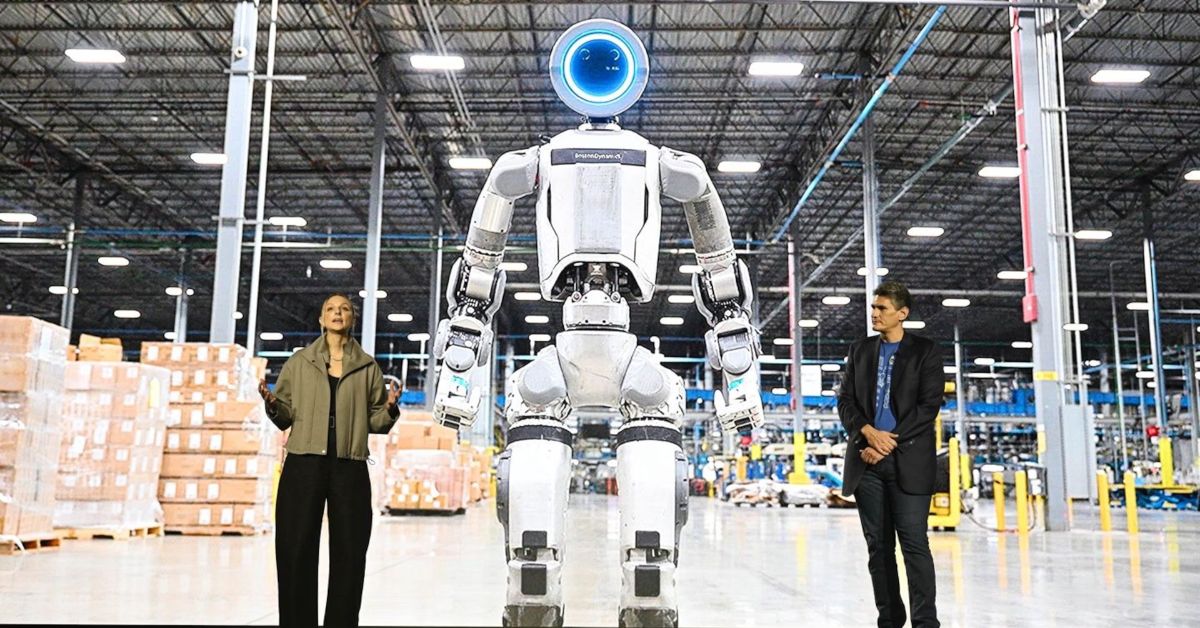
Hyundai Motor Group is transforming its new MetaPlant America in Ellabell, Georgia, into one of the most advanced automotive factories in the world. Robots already outnumber humans at the site, handling tasks from parts transportation to quality inspections, and by 2028, Hyundai plans to deploy humanoid robots developed by Boston Dynamics to work alongside people in higher-risk and repetitive roles.
🤖 Robots Take the Lead
Hyundai’s MetaPlant America (HMGMA), which began construction in 2022, represents a bold vision for the future of car manufacturing. Unlike traditional plants where automation is limited to presswork and body assembly, Hyundai’s Georgia facility integrates robotics across nearly every stage of production.
- Autonomous Mobile Robots (AMRs): These waist-high machines transport parts across the factory floor, replacing forklifts and manual labor.
- Vehicle Handling Robots: Specialized robots move partially assembled cars between stations.
- AI-Powered Quality Inspection: Robots equipped with sensors and cameras check for defects in real time.
This level of automation reduces human error, increases efficiency, and ensures consistent quality.
🏭 The Vision of “Physical AI”
Hyundai’s long-term plan goes beyond conventional robotics. By 2028, the company intends to introduce humanoid robots at the Georgia plant.
- Atlas Humanoid Robot: Developed by Boston Dynamics, Atlas is designed to perform complex tasks that require dexterity and mobility.
- Roles: These robots will take on repetitive, dangerous, or physically demanding jobs, such as lifting heavy components or working in hazardous environments.
- Integration: Hyundai envisions robots collaborating with human employees, creating a hybrid workforce where machines handle risk while humans focus on supervision and innovation.
This initiative is part of Hyundai’s broader push into “physical AI,” where artificial intelligence is embodied in machines that can interact with the physical world.
🚀 Benefits of Robotic Employees
The deployment of robots at Hyundai’s Georgia plant offers several advantages:
- Efficiency: Robots can work continuously without fatigue, increasing production speed.
- Safety: Dangerous tasks are shifted away from human workers, reducing workplace injuries.
- Consistency: Automated systems ensure uniform quality across vehicles.
- Scalability: Robots can be programmed to adapt to new models and processes quickly.
For Hyundai, this means faster rollouts of new electric vehicles and greater competitiveness in the global market.
⚖️ Challenges and Concerns
While the vision is exciting, it also raises important questions:
- Job Displacement: As robots take over repetitive tasks, what happens to human workers? Hyundai emphasizes collaboration, but retraining programs will be essential.
- Cost: Developing and deploying humanoid robots is expensive, and the return on investment will depend on long-term efficiency gains.
- Reliability: Robots must be resilient to factory conditions, and downtime could disrupt production.
- Ethics: The balance between automation and human employment will be closely scrutinized by policymakers and communities.
🌍 Global Implications
Hyundai’s Georgia plant is not just a local experiment—it’s a signal to the global automotive industry.
- Benchmark for Automation: Other automakers will likely follow suit, accelerating the adoption of robotics worldwide.
- Shift in Workforce Skills: Future factory jobs may focus more on supervising robots, programming, and maintenance rather than manual labor.
- Competitive Edge: By leading in automation, Hyundai positions itself as a pioneer in EV manufacturing efficiency.
🔮 The Road Ahead
By 2028, Hyundai’s Georgia plant could become the first U.S. automotive facility where humanoid robots are part of the workforce. This milestone will mark a turning point in manufacturing, blending human creativity with robotic precision.
The plant already demonstrates how automation can redefine production, and with humanoid robots on the horizon, Hyundai is pushing the boundaries of what’s possible in industrial innovation.
🏁 Conclusion
Hyundai’s Georgia MetaPlant is more than a factory—it’s a glimpse into the future of work. Robots already handle much of the production, and humanoid robots are set to join the workforce within the next few years. While challenges remain, the benefits of efficiency, safety, and scalability are undeniable.
As Hyundai embraces “physical AI,” the Georgia plant stands as a symbol of how technology can reshape industries, redefine jobs, and set new standards for global manufacturing.